Curata is a cross-medium creative canvas that maps your aesthetic DNA through images, songs, films, colors, and words you actually choose, so your taste becomes something you can see, articulate, and act on.
As UX Design Lead, I drove the project from concept to prototype, ensuring the product vision, design system, and end-to-end interaction design was seen all the way through while directing a small team of five others toward our May showcase deadline.
ROLE
Product Design Lead
Nicole Luu, Tracy You, Sarah Edwards,
Nupur Gorkar, Yuri Yang
Figma, FigmaJam, After Effects
Dec. 2025 - May 2026
TEAM
TOOLS
DURATION




REFLECTION
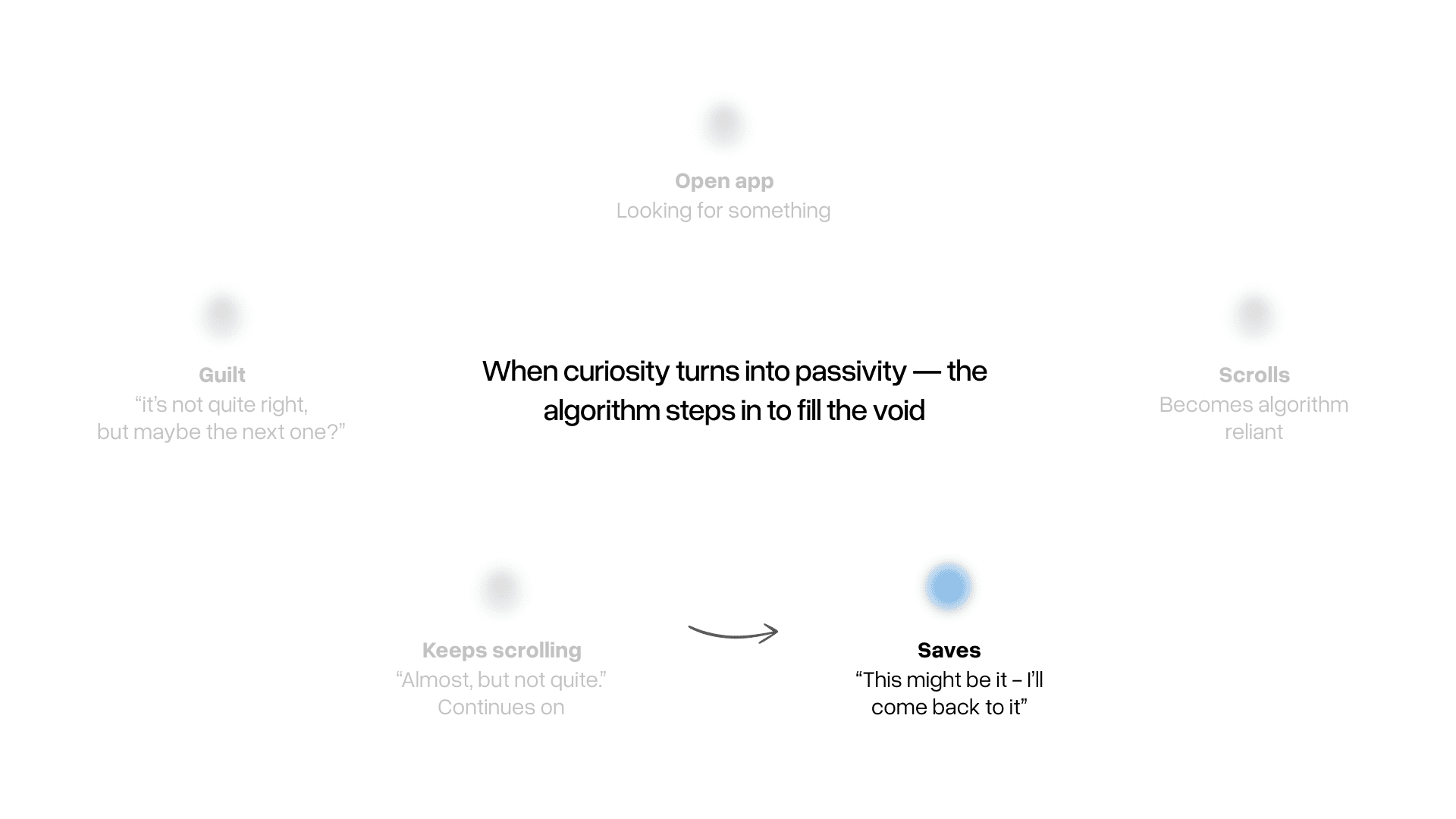
The continuous loop by design
Based on 16 literature reviews, we found that doomscrolling isn't laziness. Research shows it's a conditioned response where the brain seeks resolution that the feed is designed never to provide. The save button becomes a false endpoint which leads to a feeling of capture without actual meaning-making.

PROBLEM
We collect everything, but at the same thing, understand nothing.
Young creatives today move fluidly across mediums — saving films on Letterboxd, pinning visuals on Pinterest, building playlists on Spotify — but each platform only knows one version of them. Inspiration accumulates in silos, driven by algorithms optimized for engagement, not self-knowledge. The result is a generation that consumes more than ever and struggles to articulate what actually resonates with them and explaining why. The feeling exists: that pull toward certain colors, textures, moods, references, but there's no unified place designed to help you read it.


USER RESEARCH
We wanted to find people that this actually spoke to
60+ Survey Responses
Found through UW clubs, creative subreddits, and design Discord communities, to capture broad creative patterns.
Ages 18–26 | Active across 3+ creative platforms
User Interviews
KEY FINDING
What people collect and where it breaks down
navigate 2+ platforms before finding what they're looking for
FRAGMENTATION
WHAT WE HEARD
75%
18%
INTENTIONALITY
actually know what they're searching for when they open an app
41%
DISCOVERY
prefer to browse and see what catches their eye first
"The endless scrolling mixed with that specific frustration of not finding what’s in my head. When the search feels more like a chore than a creative spark, it definitely does more harm than good.
Interview participant when asked to describe the feeling of not being able to find inspiration you are looking for
People know something is missing, they just don't have the words or the tools for it yet. Across 16 interviews, four main pain points resurfaced consistently

COMPETITIVE ANALYSIS
Understanding existing apps and building a middle ground foundation
Hover over each circle to learn more about how competitive analysis shaped our decision making


User Curation
Manual & Intentional
Middle Ground



Algorithmic Discovery
Behavioral & Automated
Finding the space no one has built for
Most platforms make you choose: search with intent or surrender to the algorithm. We wanted to find the middle ground: a tool that learns from what you save, but keeps you in control of what it means.
IDEATION
How might we help users map their aesthetic identity across mediums to enable intentional discovery and transform passive consumption into creative action?
Goals for design:
I want people to feel seen by their own taste, not defined by an algorithm.
I want saving to feel like the beginning of understanding, not the end of it.
I want discovery to feel intentional, something you do, not something done to you.
I want your aesthetic identity to emerge naturally, across every medium you love.
Exploring the different features that our app could align with
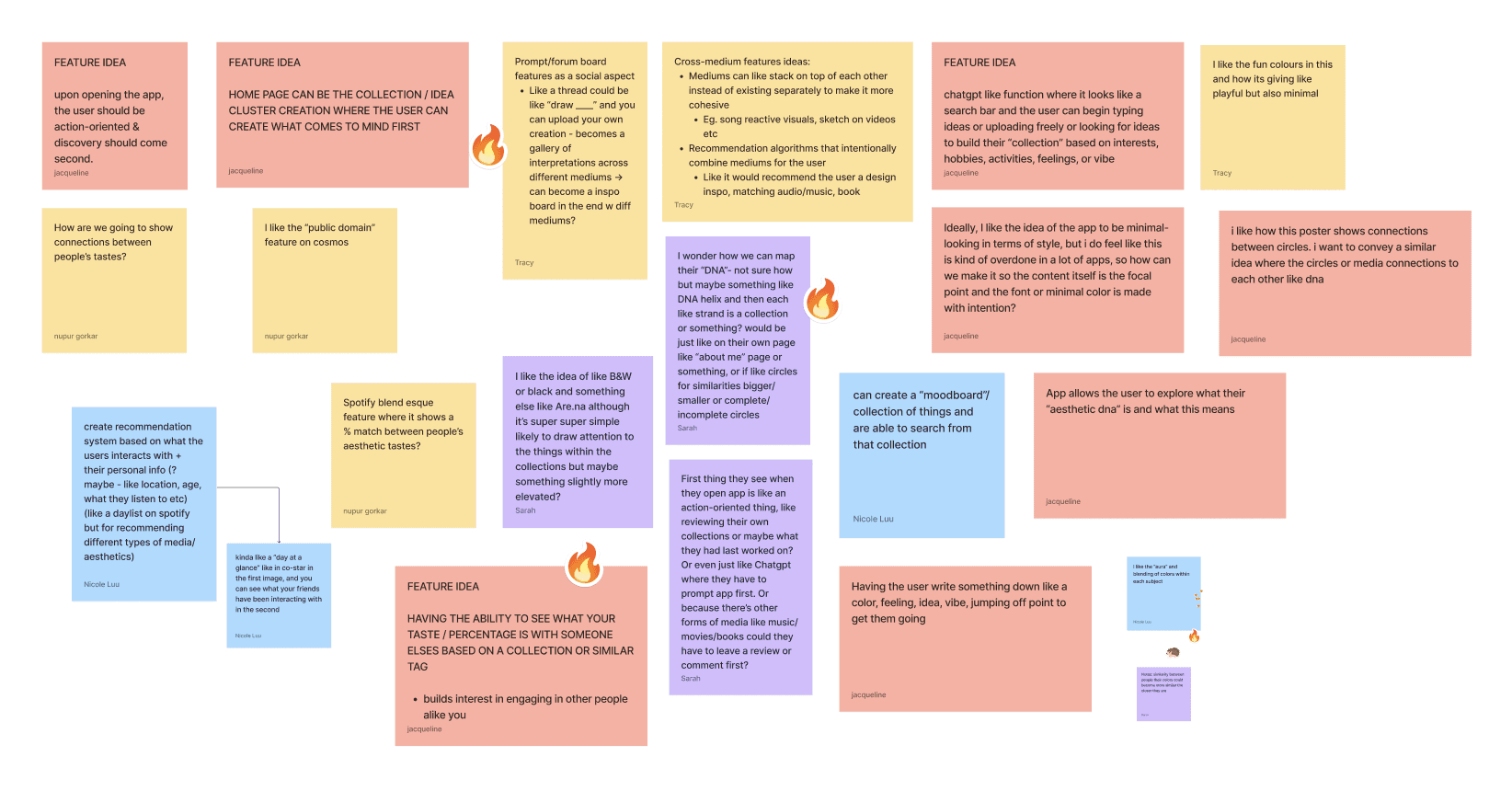
To kick off ideation, I led my team through a collaborative whiteboarding session where we each threw out questions, feature ideas, and gut reactions without filtering. The goal for this wasn't to solve anything yet, instead I wanted to get everything out of our heads, so we could see where our thinking overlapped and where tensions were.
DESIGN APPROACH
Mapping the core journey before touching screens
Before diving into wireframes, we mapped out the full user journey to align on key decision points from how someone enters the app to how their taste profile builds over time.

The inner system:
Wander doesn't show you everyone, it surfaces people whose collections share a specific media point with yours, whether that's a film, a song, or a tag like "nostalgic" or "whimsical." Your identity profile isn't assigned to you. It emerges from the language you use to describe what you save, incorporating the system for tagging collections intentionally
EARLY DESIGN DECISIONS FROM ITERATION
Our central idea started with a textbox
We hypothesized that giving users a free-form prompt — "Type a vibe, feeling, or concept" — would be the most intuitive entry point. But when we tested this with a small group of users, a pattern emerged quickly: people froze. Describing your feeling from scratch with no visual reference is harder than it sounds.


From observation:
People weren't able to think of what to write at the top of their heads
It's difficult to describe taste if you haven't seen anything to correspond with it
This led us to our new entry point -> Recognition is valued over articulation
WIREFRAMING
Designing around recognition, not description
Once we shifted the entry point, we reworked the core flows around showing rather than asking, letting users respond to content rather than generate words from nothing.
Stage 1 - Onboarding
Stage 2 - Collections and creating
Stage 3 - Wander (explore page)
Stage 4 - Identity profile page
Learning how to create a collection
Adding media
Based on tags, the identity nodes form
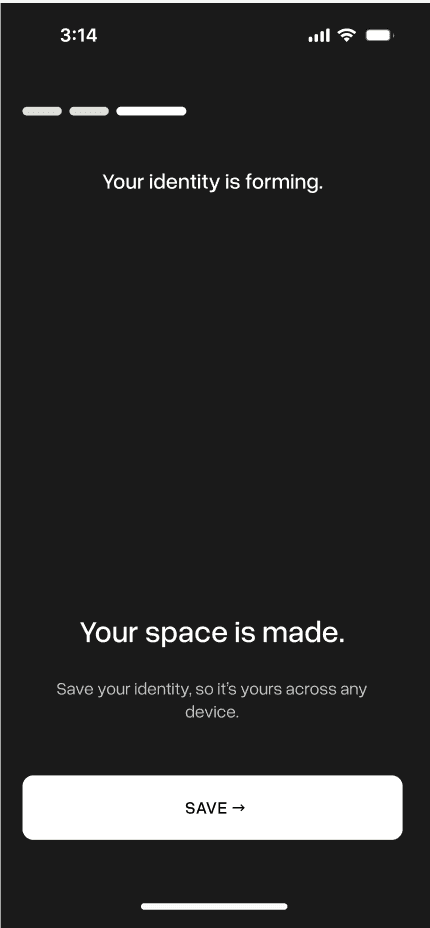
Save the space you made
Create account to see more


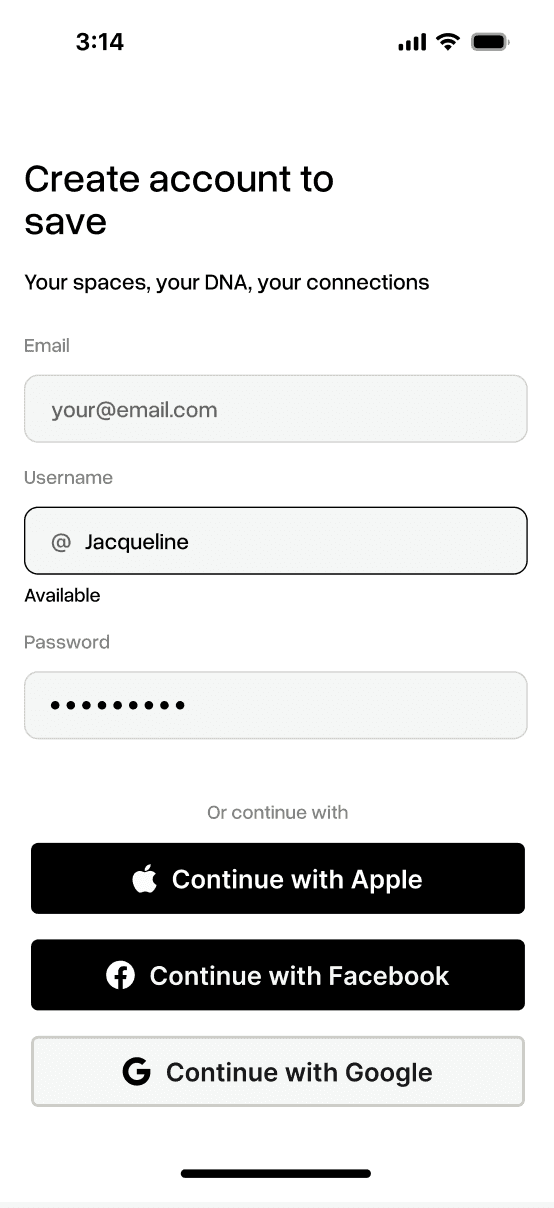



Picking different media for creating a collection
Example: image and video
What the collection looks like when building
Your collections space
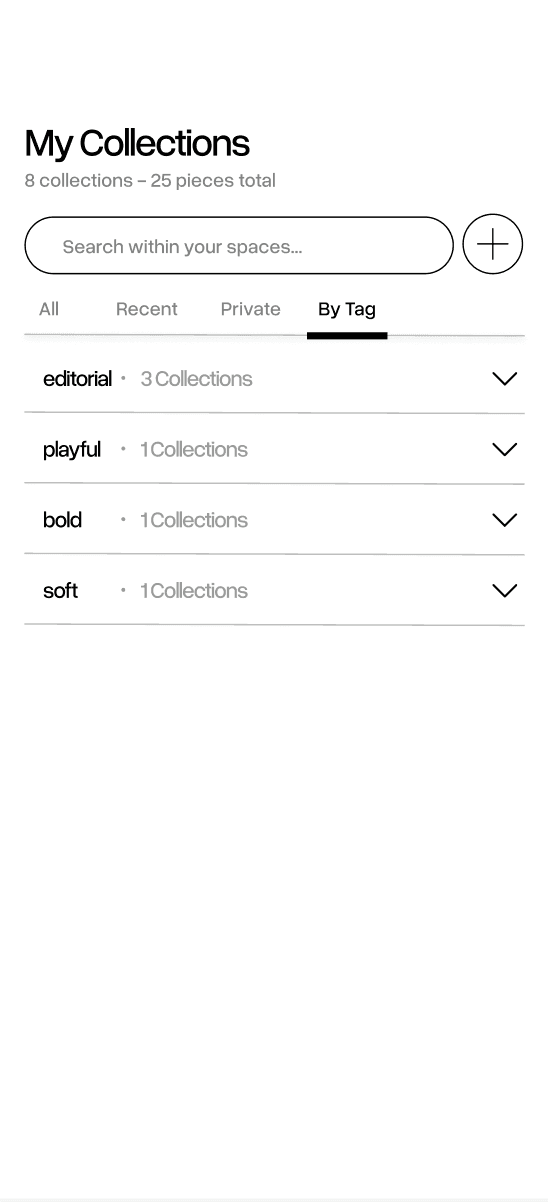
Filtering collections by the tags you have used
Showing the collection


Collections view
Profile view
Profiles (caught up to date)
When search is pressed
When you click on someone's profile


Profile page
When you explore your curated DNA
Based on tags, see the collections that correspond
Your following list
VISUAL DESIGN
Curata's interface stays refrained by design. Dark base, warm whites, one blue accent because the media is the story I wanted to portray to users. The three-ellipse logo reflects the app's core idea: distinct things overlapping into something new.


FINAL DESIGN
Introducing Curata: A cross-medium canvas that turns what you save into a picture of who you are.
Curata creates space for collecting across images, films, music, and words — then surfaces the patterns and feelings that connect them, helping you see not just what you love, but what it says about you.
CORE FLOWS
Create from the daily prompt or build from a blank canvas. Users build a space before they fill it — naming it after a mood or memory, then adding images, music, and film as it takes shape. The tags are what build the user constellation profile.
Creating a collection
Your taste, made visible. As feeling tags accumulate, a DNA profile forms — turning scattered saves into a picture of who you actually are. You can look back at the collections within each "feeling" to remember what each collection meant to you,
Identity Profile
Collections Library
Ideas
Saved spaces live together, filterable by the tags you've used. Ideas borrowed from other people's boards expire after a set window, pushing inspiration into action instead of letting it pile up unused. Drafts hold unfinished collections so creation stays low-pressure, letting you step away and return without losing momentum.
Your collections
Wander
Discovery through resonance, not algorithm. Users explore collections connected by a shared song, film, or tag — surfacing people who see the world similarly, not just what's trending.
NEXT STEPS
What I would do next
Expand cross-medium support
Curata currently handles images, music, and film well, but books, fashion, and physical objects are underdeveloped. Building out richer support for those mediums would make the DNA profile feel more complete for users whose taste lives outside visual and audio formats.
Refine the Wander algorithm
Right now Wander surfaces collections based on shared tags and media points, but the logic is still simple. I'd want to explore how to weight resonance — should a shared obscure film matter more than a shared common tag like "aesthetic"? Getting this right is core to making discovery feel earned rather than random.
Conduct usability testing
We didn't get to user testing before our showcase deadline, so the next priority is validating our key design bets — does tag-based onboarding actually reduce the friction we saw in research, and does the Ideas expiration window create urgency without feeling punitive. Real usage data would tell us if "recognition over articulation" holds up outside of our own assumptions.
REFLECTION
What I learned from Curata

Leading without a title
Directing a team of five toward a single showcase deadline taught me that leadership isn't about having the loudest opinion in the room, it's about knowing when to make a decision and when to let the team's instincts guide the work flow. I learned to hold the vision firmly while staying open to ideas that sharpened it.
Designing for feeling, not just function
Curata's entire premise rests on emotion and the quiet guilt of an unused save, the relief of being understood. This project taught me that interface decisions carry emotional weight whether you intend them to or not, and that the most resonant design choices come from naming a feeling precisely before solving for it.
Knowing when to cut an idea you love
Our whiteboarding sessions produced far more features than we could ever build. Letting go of ideas that were exciting but didn't serve the core thesis was harder than generating them in the first place, but it taught me that restraint is often the more difficult and more valuable skill in design leadership.
